Tuesday, October 31, 2006
New Low Cost Carrier Operating from....Columbus, Ohio???
 In an unprecedented move for a startup airline in the U.S., last week Skybus announced an enormous order with airplane manufacturer Airbus for 65 new Airbus A319 aircraft. The order is said to be worth more than $3 billion.
Cletis's prediction: A year or two after launching, Skybus will be a memory.
Curiously, Skybus is to be based in Columbus, Ohio--a medium-market city with a population of just over 700,000. Although details of the new carrier are sketchy, it appears that Skybus intends to link secondary cities, and intends to connect them through Columbus.
Skybus does seem to have some pretty positive things going for it. First, they have started with more than $100 million in financing. Second, they have chosen to model the airline on Ireland's successful Ryanair. Moreover, they have attracted the help of some top industry executives to help run the thing, including Ryanair's yield manager, Jim McMahon (not the Bears' former quarterback). And finally, they've decided to launch with an all-new A319 fleet; an airplane proven to provide exceptionally low per-seat costs, and rather popular with passengers.
But industry insiders are not optimistic about Skybus's chances for success. First, and perhaps most problematically, most industry insiders believe that the Low Cost Carrier (LCC) segment of the U.S. air carrier industry is fully saturated--in other words, that all of the routes that can be economically operated by LCCs have been picked clean by existing carriers. Second, Skybus made the unusual choice of choosing Columbus, Ohio as their base of operations, which they plan to use as a hub for connecting traffic. The problem with this is that any LCC employing a hub depends on a significant amount of traffic originating in destined for the hub city (called "O & D" traffic). jetBlue, another LCC with a hub, chose New York City precisely for this reason. But at best, Columbus is a medium-market city that can't supply much O & D traffic. This problem is compounded by the fact Skybus is kicking off service with 65 planes, which means that there will be a tremendous amount of traffic flowing through Columbus. And finally, Skybus's decision to model itself on Ryanair may not go over well with the American traveling public. Ryanair is truly a bare-bones operation. No window shades. Seats don't recline. And the seats don't even have seat-back pockets in front of them. While we Americans may like low fares, one has to wonder whether people will be willing to crowd into airplanes that make San Francisco Muni's 30-line feel like a day at the Four Seasons.


Monday, October 30, 2006
New Option for San Francisco to San Diego: Alaska Airlines
This will add additional competition to a route already dominated by Southwest Airlines, which operates from Oakland. Perhaps residents of San Francisco won't have to trek across the Bay Bridge to the beautiful Oakland airport in order to get a decent fare to San Diego.
By the way, I once saw a mouse running up the filthy baggage carousel at Oakland. Nothing but class over there at OAK....
More Ominous News for Airbus: Emirates Cancels Order for TEN Airplanes
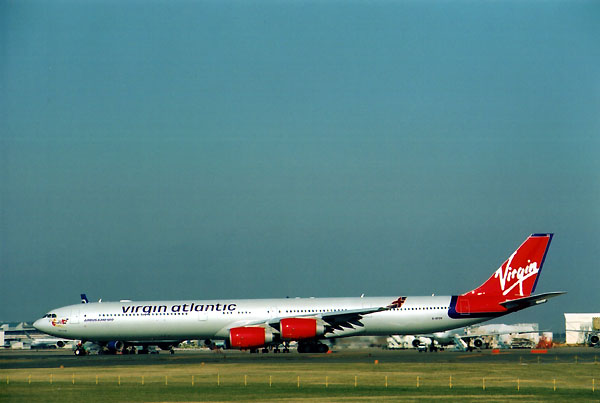
The A340-600 (shown at right in the Virgin Atlantic livery) is the largest airplane currently in Airbus's fleet. It typically seats about 380 passengers and has a range of about 7,900 nautical miles. But the A340-600 also has four engines, which makes it much more expensive to operate with the current insane fuel prices.
 Meanwhile, Boeing's competing airplane is the 777-300ER (shown at left in the Emirates livery). It seats 365 people and has virtually the same range as its Airbus counterpart--it can go 7,880 nautical miles. But the big difference between it and the Airbus is that the 777 only has two engines, which is far less costly to operate.
Given the significant cost savings, most airlines, like Emirates, are choosing the 777 over the A340. The A340 was yet another miscalculation by Airbus (a subject for another post).
The bigger story, however, is that this could be an even more ominous sign for Airbus in light of the substantial delays in the super-jumbo A380 project. Emirates is a launch customer and has ordered more A380s than anyone, and stand to lose a great deal from the delays. Some industry experts believe that it's possible (but not likely) that Emirates may cancel their order for the A380.
Sunday, October 29, 2006
BEST Flight Tracking Website

The BEST flight tracking website for domestic flight in the U.S. is called FlightAware. Check 'er out at: flightaware.com.
Not only does this great website provide the same nifty diagram showing where the plane is enroute, it provides a ton of other information you're not going to get elsewhere. I recommend registering with the website (it's free), as it gives you access to some additional gadgets.
One great feature of FlightAware is that you can find out when a flight you're planning to take actually departs and arrives. For example, let's say you're planning to take US Airways (USA) flight 749 from Philadelphia (PHL) to Las Vegas (LAS). The flight is set to depart PHL at 8:30 p.m. and is supposed to arrive LAS at 10:30 p.m. You want to meet your buddies at the airport, who are coming in from California at about the same time.
One of the great tools that pops up on a FlightAware flight search is called an "Activity Log," which shows the actual departure and arrival time of this flight for the previous ten days or more. And if you look at the Activity Log for USA 749, you see that it almost never departs on time. Most often the flight departs at 9:00 p.m. or later--more than 30 minutes late. Armed with this valuable information, you could tell your friends who are meeting you at LAS to just go along to the hotel without you, because you know you're going to be late as hell.
A lot of the other great features of this website are pretty geeky, but pretty fun to play around with.
- You can look at the altitude, speed, flight path, scheduled and actual flight duration and the filed flight plan for all commercial flights and for many private planes.
- You can search for all flights between any two cities (just be sure to type a 'K' before the airport code for U.S. airports--so searching for SFO on this website would be KSFO)
- In addition to looking at specific flights, you can also look at the activity at any given airport too see all the arrivals, departures, and scheduled arrivals and departures.
- And if you're a real airplane geek, there's a feature that allows you to search for all airplanes in U.S. airspace of a particular type. For example, if you want to know about every 777-300 that's in the air, you could search for it, and you'd get a result that looked like this:
And for international flights, try Aeroseek. It's also got some pretty cool tools.
Enjoy!
Tuesday, October 24, 2006
New Airline Connecting City Centers: Welcome Porter Airlines! (GEEK POST)
Yesterday, a new entrant airline called Porter Airlines started operating in Toronto, Ontario.
 What's so unique about Porter, however, is that instead of operating from Toronto's primary airport (Pearson Int'l, aka "YYZ"), which is way out in the Toronto 'burbs, they're operating from a small airport called the City Center Airport (YTZ). YTZ sits on an island in Lake Ontario, just a couple hundred yards from Toronto's financial district. The ferry ride out to the island takes just eight minutes. Due to this short ferry ride, and the minimal security lines at YTZ, passengers need not leave their offices or homes two hours before their flight is scheduled to depart.
Although Porter launched service yesterday with flights only to Ottawa, its plan is to start adding destinations to city-centers within a 500 nautical-mile range of its Toronto base. As I'm sure you've figured out by now, Porter has positioned itself to attract primarily business travelers who would benefit most from the convenience of the airline's operating from YTZ, and in the future, from other small-ish city-center airports.
Why haven't existing airlines filled this niche yet? Simple. Most existing air carriers in North America are lemmings. They have no original ideas. Instead, they follow whatever the rest of the industry is doing, even if it's dumb.
To wit: Unless you haven't set foot on an airplane in the last six or eight years, you've noticed that all the airlines have blindly followed each other in replacing their turboprop airplanes with regional jets. Many of the Majors (and their affiliates and partners) have abandoned turboprops altogether. While it's true that regional jets are faster, quieter, smoother, and preferred by customers, one problem with regional jets is that the shortest flights aren't very profitable to operate.
Consider a business traveler who's trying to decide whether to either drive to Ottawa from Toronto (about 250 miles) or fly on an existing regional jet-serviced route (to the extent that they even exist on such short trips). Driving would take about four hours. But flying on a Major carrier's regional jet flight (which means going to the bigger, international airports with longer runways, that's far from the city center and takes a long time to get checked in and through security), it would take about 3.5 hours (leave office two hours before the flight to arrive one-and-a-half hours before the flight, one hour flight, and thirty minutes from the airport to the destination in Ottawa). Given that the times are about the same, but the costs to fly would be far greater, most business travelers probably would prefer to drive given those choices.
So when the Majors followed each other and ditched their turboprops for regional jets, they left a bunch of short flights (and profitable business passengers) unserviced or under-serviced.
Enter Porter. They saw that there were these very profitable customers who'd prefer to see city-centers get linked. While everybody else was giving their turboprops to the Salvation Army and whatnot, Porter placed an order for a whole mess of Bombardier Q400 turboprops. These suckers are somewhat big (seating 70), relatively fast for turboprops (cruising at 414 mph), extremely efficient to operate, and can land on very short runways (ideal for small, city-center airports).
With these efficient turboprops, Porter can operate from YTZ in Toronto (where customers need not leave their offices until, perhaps, 45 minutes or an hour before their flights), and can get customers from Toronto to Ottawa (door-to-door) in about two hours and fifteen or two hours and thirty minutes. This is a significant time savings over flying from YYZ or from driving the whole way. Porter may make sense.
The threats to Porter's success (and anyone else who follows in their footsteps) are numerous, however. First, people in Toronto are fighting the commercial use of the City Center Airport, citing safety and environmental concerns. Oddly, even the mayor has jumped on this bandwagon. So the use of this airport, and other similar airports that are close to city centers, is by no means a done-deal.
Second, it would be relatively easy for existing carriers to come in and compete on the same routes (note, though, that Porter is the only airline allowed to operate from YTZ in Toronto right now).
Third, existing carriers have proven fairly adept at retaining high-yield business travelers with frequent-flier programs and other retention initiatives. And Air Canada has begun selling airline trips in pre-paid bundles, which allow business travelers to buy a certain number of flights for a set price, and they may be used at virtually any time. For budgeting purposes, corporate travelers may prefer the predictability of these pre-paid, bundled tickets.
Fourth, Porter will always struggle to ensure that their operations are more efficient than driving or flying on the Major airlines out of bigger airports. Are there that many city-center airports within range of Toronto?(Not really.) What happens when increased traffic through City Center Airport in Toronto means it's not so much faster? What happens if Toronto succeeds at booting Porter out of the City Center Airport?
All-in-all, this will be an interesting experiment, to see if Porter can grow this business to connect city-centers efficiently and attract high-yield business travelers. If it works, similar operations could be successful in other high-density areas with convenient, city-center airports. Only time will tell...
Monday, October 23, 2006
jetBlue Posts a Rare Loss Last Quarter
 jetBlue, one of the few airlines that Wall Street actually seems to like, posted a rare (but small) loss of a half-million bucks last quarter.
So how did this very popular and successful airline manage to lose kwan last quarter?
Among the many reasons, three stand out. First of all, jetBlue has been growing faster than my waistline. They've been opening new cities and taking delivery of many, many new airplanes very quickly. Although this may be counter-intuitive, in almost any industry, ultra-fast growth can be a bad thing because the costs related to the growth outpace the cash flow.
Second, the current thinking in the industry is that domestic carriers (like jetBlue), who tend to fly shorter routes than international carriers, probably suffered the most from the London terrorist plot to bomb airplanes over the Atlantic. Because of the annoyance of not being able to carry on liquids, and the fact that the traveling public may (incorrectly) believe that this new limitation adds to travel time, perhaps some people may choose to drive rather than fly.
Finally, jetBlue broke with the tried-and-true practice of virtually every successful Low Cost Carrier (LCC) during the last year by introducing a second airline type into its fleet--the 100-seat Embraer 190. Nearly every successful LCC has stuck with one airplane type; Southwest Airlines, Ireland's Ryanair, Australia/New Zealand's Virgin Blue, Canada's WestJet, and India's SpiceJet all operate only Boeing 737 airplanes; and Frontier Airlines operates only Airbus A320-family airplanes. LCCs usually operate only one airplane type because it is far less expensive, for a variety of reasons.
jetBlue is doing something about this, however. The company has slowed their growth, and has begun a campaign to reduce costs system-wide. We'll see what happens!
Sunday, October 22, 2006
An Open Letter to Really Fat People: Buy Two Seats
Dear Really Fat People:
I write this letter not to be mean, not to unnecessarily single you out, and not to embarrass you. To be honest, I'd rather not have to write this at all. But unfortunately, circumstances have made this letter necessary. I have just one message for you: If you don't fit entirely within your own airplane seat, for the love of god, buy two damn seats.
Don't get me wrong--I'm a rather rotund individual myself. I have no axe to grind with fat people of any size. But the difference between you and me is that I manage to squeeze myself into my own coach seat, and you don't.
I also take no position one way or the other as to whether obesity is a disability that should be accommodated by the airlines. That's between you and the airlines (although the current state of the law does not require airlines to accommodate obese passengers with two seats). But I do know that it should not be my problem (as my dad says, "don't make your problem my problem!"). I paid for my seat. You paid for your seat. Nothing entitles you to take part of my paid-for seat without my permission and without compensating me.
To the giant man on my jetBlue flight from Oakland to Boston this past summer, what the hell's your problem? Even if you couldn't buy two seats, what on Earth made you decide to choose a middle seat! You made me (on the aisle), and the lady on the window miserable for the entire 5-hour flight. Your chest-level fat roll and first stomach-level roll were wedged into my arm. Your enormous arm was resting over my damn shoulder and side. Your butt's lower fat roll also encroached at least two inches under the armrest into my seat. As you were all over me and the lady in the window seat, we were sweating our asses off. The flight attendant saw this and brought us each icebags to put on our necks! In short, this was my worst flight experience ever. You should have bought two seats!
To the enormous (but short) woman on my American flight from Miami to San Francisco a year ago, even though you were very sweet, if you had any manners, you'd have gotten yourself two seats also. You encroached into my space, too.
 But what's worse is that it seemed as though there were areas of your body that were beyond the reach of whatever cleaning apparatus you use in the shower. As a result, you smelled horrible. Like terrible cheese. Limburger cheese. Wrapped in a homeless man's undies. That's so unfair. Next time, darlin', get yourself a second seat.
So let's agree on this: If you don't fit in the area bordered by the inside edge of the armrest, ya gotta get yourself another seat.

Very truly yours,
Cletis Walkman
Five Basic Tips For Finding the Best Airfare
- Travel on Tue, Wed, or Thu. Demand for tickets is lowest on these days, which means that travel on these days is cheaper. So if you can try to schedule your flights on Tuesday, Wednesday, or Thursday, you're likely to find some better deals.
- Avoid preferred airports. In markets where there are more than one airport, quite often travel through secondary (or tertiary) airports can be cheaper. Thus, if you're price sensitive, it frequently makes sense to look at these less-preferred airports. Examples: In San Francisco, try Oakland (OAK) or San Jose (SJC). In New York, try Islip (ISP). In Boston, try Providence (PVD) or Manchester (MHT). In Los Angeles, try Burbank (BUR), Long Beach (LGB), or Ontario (ONT). In Chicago try Milwaukee (MKE). In Dallas try Love Field (DAL) (where Southwest recently became able to sell tickets anywhere in the country). In Houston, try Hobby (HOU). In D.C. try Baltimore-Washington (BWI). In London, try Luton (LTN) or Stansted (STN). In Paris, try Orly (ORY). In Rome, try Ciampino (CIA). In Toronto and Buffalo, try Hamilton (YHM). And in Cleveland, try Canton-Akron (CAK).
- Be willing to change planes. Generally speaking, the airlines know that the people in the biggest hurry to get somewhere are willing to pay a premium for this privilege. For this reason, if you're looking to save some kwan, be willing to buy longer itineraries that involve stop(s).
- Check everywhere. Taking the time to research fares thoroughly is always in your best interest. I always start with a website that reaches into other websites and searches for the lowest fares. It's called Kayak. After that, I'll often check out a few other sites, like Cheaptickets, Orbitz, or Expedia (and in Europe, also try 1800CheapSeats). Keep in mind that Kayak doesn't search Southwest, and Cheaptickets, Orbitz, and Expedia don't check Southwest, jetBlue, and other Low Cost Carriers (LCCs). Finally, I'll check out the websites of the airlines themselves, because sometimes they have inventory and prices that don't show up anywhere else on the Internet.
- Look in advance. As a general rule, it makes sense to start looking for your airfare in advance of your trip, but not too far in advance. Usually you want to buy your airfare more than 21 days before you travel. But if you search too far in advance--say, more than three months before your trip--you may not find the best deals. This is because the complex computer systems that allocate prices often don't begin to generate the lowest airfares until closer in time to the flight (this process is called yield management, which I'll talk about another day).
There are quite a few exceptions to this rule that you must be aware of. First, it usually pays to buy as far in advance as possible if you're planning to fly on an LCC, which use much more simplified systems for allocating prices to seats. It's usually first-come, first-served for the cheapest tickets. It also makes sense to be looking for international tickets as far in advance as possible, primarily because there's so much less inventory available (though this appears to be changing, but only time will tell). Finally, if you're planning domestic travel inside the U.S. on or near a major holiday (Thanksgiving, X-Mas, Memorial Day, Labor Day, and Easter), again, because of limited inventory, it frequently makes sense to begin looking as far in advance as possible.
Bay Area Fliers: Avoid SFO Between January and March
I'll explain why this is below. But the message to take away from this post is simple: If ya need to get somewhere by air from Jan-Mar, and ya can't afford the get stuck in the airport, fly from OAK instead of SFO. Even though the cab ride and BART trips from OAK to San Francisco are more expensive than from SFO, and even though Greyhound would be embarrassed as hell if any of its bus stations looked like OAK, it still makes sense to fly through OAK.
So, wtf? Why is that?
The explanation is simple.
 As you can see from this picture, SFO's runways are laid out like an 'X', with two parallel runways going in each direction of the 'X'. Normally, two airplanes can land at the same time (one on each of the two parallel runways--this is called "simultaneous parallel operation"). The airlines rely on this in planning their schedules in and out of SFO. Without simultaneous parallel operations, SFO couldn't handle all of the traffic that the airlines schedule.
But compared to many other airports of its size (Los Angeles, Denver, Atlanta, Chicago, etc...), SFO's parallel runways are very, very close to each other. For this reason, the FAA doesn't allow parallel ops into SFO when the weather gets cruddy and the visibility drops. The problem is that the airlines still have just as many flights scheduled to land at SFO during those times. Because SFO's capacity is essentially half of what it normally is, what you end up with are too many flights arriving and not enough landing slots to fit them all in. Arrival delays quickly mount to two hours or more. Arrival delays lead to departure delays. And this leads to the entire airport becoming one ferkakte (i.e., lousy or screwed up) disaster zone. This is one of the reasons that Southwest and many of the other Low-Cost Carriers (LCCs) operate out of OAK instead of SFO (more on this another day).
 OAK, on the other hand, only has one runway used by commercial carriers (it's the longest one on the left of the diagram). Thus, during even the best weather, the airlines can only schedule arrivals on the one runway. So when the weather turns bad, OAK doesn't have its capacity cut in half like SFO. Even though arrivals are a little bit more spread out, delays are rare.
Until the day comes that SFO can move its arrival runways farther apart (chances are that we'll develop teleporting before this happens), SFO will continue to be screwed in bad weather, while OAK is hardly impacted. For this reason, if you need to travel to or from the Bay Area from January to March and your time is tight, try OAK instead of SFO.
Airbus's New A380: Long Way Off From Breaking Even
 Now, because of a laundry list of production problems resulting in significant delivery delays (more on that another day), this week Airbus said that it would need to sell 420 A380s to break even. And to date, Airbus only has orders for about 159.
Ouch.
Just to break even, Airbus needs to collect orders for 261 more planes, at a list price of more than $78 billion.
An early A380 painted in the Emirates livery. (Photo by Jonathan Bender)
Friday, October 20, 2006
Airports to AVOID this Holiday Season
What to do? Other than tearing somebody's arm off and stuffing it down their throat, one way to avoid a lot of this BS is by structuring your trip to avoid problematic airports.
- Fly non-stop. This avoids many of the problems of missed connections, poor weather, and lost luggage. Even if the price is greater, it's probably worth it at this time of year to avoid aggravation.
- Avoid riskiest airports. Chicago O'Hare (ORD) is a high-risk and must be avoided at all costs. Bad weather is the major problem at ORD, which invariably leads to most of the other crap. Also, ORD is one of the few capacity-constrained airports in the U.S., and it gets completely inundated around Thanksgiving and X-Mas. Because both American and United have hubs there, it's pretty tough to avoid ORD, but definitely worth it at this time of year.
The following airports are somewhat risky at this time of year, and should be avoided, if possible: Minneapolis (MSP) and Detroit (DTW), both Northwest hubs, and Cleveland (CLE) and Newark (EWR), both Continental hubs. - Best airport bets. If you must change planes, try Houston Intercontinental (IAH), a Continental hub, Dallas-Ft Worth International (DFW) and Miami (MIA), both American hubs, Phoenix (PHX), Las Vegas (LAS), and Charlotte (CLT), all US Airways/America West hubs, or even try Denver (DEN), a United hub, which is frequently pretty dependable before January.
- Plan longer layovers. The shorter your layover, the more likely you are to miss the connection, or have your bags miss the connection, in case of delay. So if you've got to connect through a hub, try to pick a layover of 90 minutes or longer.
Best of luck with your holiday travels. If it goes to shit though, try alcohol or painkillers.
Welcome aboard!
We all fly. We are all exasperated by the current state of air travel because, quite frankly, it generally stinks. But there's tons of information out there that can make the air travel experience a tiny bit better. The object of this blog is to get that information out there to as many people as possible.
This blog also has a second purpose; to satisfy the airline geek in all of us. There’s something about air travel that seems to pique the curiosity of even the most wearied, hardened business travelers. So I plan to include all kinds of useless but interesting info about air travel.
Thanks for reading The Airline Bottom Line. Welcome aboard.


