Wednesday, December 13, 2006
Cletis's Rules of Airport (and all other) Bathroom Etiquette for Men (Digestion Post # 3)
Amen.
"DIVIDERLESS" URINAL ARRANGEMENT
1) Please remember that maintaining maximum horizontal urination separation is the primary concern in a dividerless urinal situation (i.e., no little partitions between urinals). Otherwise, issues like splashback, stagefright, and inadvertent penile viewing may arise. Please note that these same rules apply to troughs and other undivided urinary regions.
So:
- First guy in, select a urinal on the end. This way, the next guy can select the urinal on the opposite end and be as far away as possible.
- Third pisser in a dividerless urinal situation must select a urinal in the very middle of the urinal bank. Subsequent pissers in such situations are to apply the same principles to maintain maximum urinary separation.
B) NEVER engage your neighbor in conversation, unless you have at least three urinals between you and your fellow conversant. If you are drunk, the horizontal separation can be reduced to two.
C) Eyes forward or up at the ceiling. Why do some people look down? Resist temptation to thread your stream through one of those little holes in the urinal. Looking down is just weird.
D) Wear flip-flops at your own risk; studies done by the PUI (Public Urinal Institute) show that 8% of urine becomes airborne upon contact with the urinal. See the wee-wee pond beneath each urinal for evidence of this fact.
NORMAL URINAL SITUATION (W/ DIVIDERS):
A) If you see a friend in the bathroom, maintaining maximum horizontal urination separation is less important. In any case, maximum separation is always a nice thing.
B) Conversation with people you know is ok in this situation.
C) Ideally, one should look up or look straight ahead. But if you're one of those people who must monitor situations down below in the urinal, it's acceptable in this situation if you absolutely must do it.
DEFECATION:
A) Almost anything goes when one is forced to evacuate his bowels in a public toilet.
B) After you leave the stall, you must ensure that you leave no evidence that you'd been in the stall engaging in a heated game of Texas Don't Hold 'Em. In other words, don't poo on the seat or floor, flush, and keep flushing until all choo-choo tracks have been erased.
C) In small bathrooms (3 or less urinals or 2 or less stalls), a pooer in a non-emergency situation is required to wait until all is clear in the bathroom prior to emitting any substantial sounds. This rules is waived for Excretory Emergencies, obviously.
D) Non-pooers are not permitted to make eye contact with pooers either on their way in or out of the stall; permit them this moment of privacy.
E) No inter-stall communications are permissible while one engages in an evacuation unless arrangements have been made in advance by both parties (in writing, preferably, with the seal of a notary public).
GENERALLY APPLICABLE RULES:
A) Do NOT contribute to any pee-pee ponds underneath any urinal; it is every man's obligation to society to reduce and eliminate such puddles. Why should one be forced to track the pee of every inconsiderate ass in the world around on the bottom of his shoes?
B) Wash your hands afterwards, for the love of god.
C) Don't touch the door handle (if there is one) on the way out of the bathroom, ESPECIALLY if you've violated rule (A) above.
D) Peaking at another guy's contraption is NEVER permissible; if that's your cup-o-tea, so be it. Just save the peepshow for somewhere else.


A Protocol for High-Altitude Eating (Digestion Post # 2)
Last week's post about flying flatulence got me thinking about a few other important digestion-related issue pertinent to modern air travel. We'll designate this post as "Digestion Post # 2.
So with most airlines cutting out (free) meal service on domestic flights, what's the protocol for bringing food onto an airplane these days?
Since this past summer's airline bomb scare, thankfully, the TSA has issued regulations that pretty much prohibit passengers from bringing any outside grub through an airport's security checkpoint. While the critical reader will quickly see how this decision really benefits the airports (airports rely greatly on concession revenues, which have taken a hit quite badly since 9/11, so this decision also has the effect of requiring passengers who wish to take food onto planes to buy that food from only airport concessions), this also greatly limits passengers' choices for the kinds of foods they can schlep onto airplanes. This is a good thing.
With airplane seats stacked right on top of each other, one cannot avoid the smell or the sight of what someone else--the seat neighbor--eats onboard. Like most other people, I've encountered some pretty uncomfortable situations on airplanes with people bringing strong-smelling or unappealing foods onto airplanes. That just ain't cool, so henceforth, all air passengers are required to follow the Cletis Food Protocol (CFP).
The CFP:
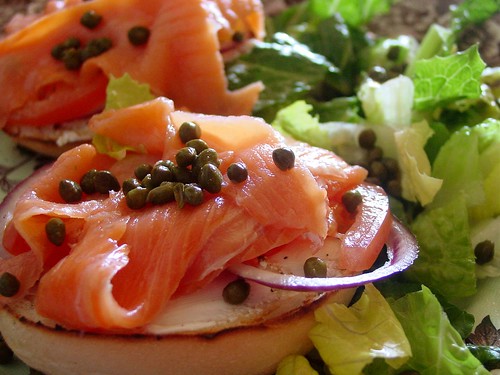
- Henceforth, all ethnic foods are prohibited from being carried onboard. For instance, I happen to love eating bagels with lox for breakfast. But in fairness to my neighbors, who may view the eating of smoked salmon for breakfast as absolutely repulsive, I skip the (skeevy) bagel place in the airport, and get something else to eat. Similarly, if you were thinking about stopping at the Panda Express for some spicy prawns, for the love of god, don't do it. Same goes for Indian food (even though I love the smell), Cajun, chili, Wolfgang Puck Express entrees, Thai food, Ethiopian food, cauliflower (I hate the smell), and Kugel in any form.
- Food must be time appropriate. If I have to endure another inconsiderate person sitting near me chowing down on a chili dog at 9:30 a.m., I may just yank the life vest from underneath my seat, tie it tightly around my throat, and pull the red tabs. For this reason, from this day forward, if you're going to eat onboard before 11:30 a.m. (based on the time of your DEPARTURE city), it must be traditional breakfast cuisine. McMuffins. Donuts. Bagels (no lox). But don't even think about breaking out that Philly cheesesteak, Double Whopper with cheese, pork rinds, or california roll before 11:30 a.m.
- Nothing messy please. It's true that I'm more of a germ freak than your average person. But to protect folks like me (the minority) from the tyranny of you (the majority) on airplanes, my CFP is designed to placate even the greatest germaphobe. Accordingly, messy foods that could splatter, drip, spray, bubble, erupt, flake, splash or otherwise contaminate the autonomous region belonging to your neighbors are strictly prohibited.
- Securing drinks in turbulent air. If you have a drink on your tray table and the pilot announces turbulence strong enough for him/her to ask the (snippy) flight attendants to "please be seated," then it is your duty to both sip down your drink to at least the half-full level, AND hold the glass steady until the turbulence ends.


I suspect that I've missed some vital flying food issues in the CFP. Please feel free post comments providing your suggestions, and I'll gladly add them to the CFP.
Happy eating!
Friday, December 08, 2006
Big Order for Boeing: Lufthansa Becomes First Airline to Order New 747-8 Intercontinental
This past week German carrier Lufthansa became the first airline to order the passenger version of Boeing's latest, greatest incarnation of its 747, the 747-8 Intercontinental.
 Although Boeing announced the 747-8 project in November 2005, until Lufthansa placed this order, no other carrier had opted for the passenger version of this plane, even though a handful of carriers have already placed orders for the freighter version.
Lufthansa selected the Intercontinental, which will seat 467, to position it between the carrier's super-jumbo A380, which will typically seat 555 in a three-class configuration when it comes to Lufthansa in mid-2009, and the carrier's A340-600, which typically seats 380 in a three class configuration.
The 747 has been in service since 1969, and has been updated more than once. The Intercontinental is the first update of Boeing's incredibly successful jumbo since 1988, when the 747-400 went into service. Beyond stretching the fuselage by more than 18 feet, which adds 51 additional seats, what really makes this latest incarnation of the 747 unique are the highly-advanced General Electric engines that were developed as part of the 787 Dreamliner project. Because of these highly-efficient engines, the new Intercontinental will be 10% cheaper to operate (on a "seat-mile" basis, which is the standard unit of measure of variable operating costs in the industry) than the current 747-400. According to Boeing, the Intercontinental will also be cheaper to operate than the A380 (reducing the cost of each trip by 19% and a seat-mile cost savings of 3%. Quite a bold claim, to be frank.
Geek note: You may be wondering why Boeing, after developing the 747-100 (launched in 1968), 747-200 (1970), 747-300 (1982), and 747-400 (1988), has named the latest version of the jumbo the 747-8? There are two reasons: First, Boeing skipped a few numbers and called this version the '-8' because they wanted to signal to customers that this airplane shares many of the technological improvements developed for the 787 Dreamliner project.
The second reason is a little less obvious. For many Chinese people, the number '4' is considered an unlucky number, whereas the number '8' is a lucky number. China has become, and will continue to be, one of the largest markets for the purchase of commercial airliners. To satisfy this, in the last 5-10 years both Boeing and Airbus have tried to incorporate the number '8' into the numbering of their airplanes, while avoiding the number '4' (the first version of Airbus's A380 has been designated as the -800 version; Airbus's forthcoming A350 will be available in -800, -900R, and -1000 variants; and Boeing's 787 Dreamliner will be offered in -800, -900, and -300 versions).
Photos:

 Boeing 747-200
 Boeing 747-300
 Boeing 747-400
 Airbus A340-600
Thursday, December 07, 2006
Cletis's Deepest Apologies for Being Absent
Luckily the mistake was cleared up. After one last waterboarding session with the kind soldiers of Guantanamo, in which they forbade me from discussing what had happened there, I was given a genuine apology (they said, "sorry about that, buddy, here's your stuff, now get the fuck outta here.") and released.
In-Flight Flatulence (Digestion Post # 1)
That's right--farting caused an airplane to have to divert.
Some passengers on flight 1053 smelled lit matches, became concerned, and reported the smell to flight attendants (lighting matches onboard an airplane is prohibited). The flight crew requested and made an emergency landing in Nashville. After the 99 passengers were removed from the airplane, bomb-sniffing dogs found evidence that somebody had been lighting matches inside the passenger cabin.
After lengthy questioning by the FBI, a woman passenger admitted to having lit the matches. She told the FBI that she had lit the matches to "conceal the odor" of her "troubled digestive system." The woman was released without charges, but forbidden to re-board her flight. American Airlines "has banned her for a long time," said a Nashville Airport Authority official.
Thankfully, this incident brings to the forefront an incredibly important issue relating to air travel: How does one politely and considerately conduct the Intestinal Symphony in Poo Minor while on an airplane?
I've checked with the guru of manners, Ms. Emily Post, to discover the appropriate etiquette under the circumstances. Quite surprisingly, Ms. Post has not addressed this issue before. I guess this leaves the resolution of travel tooting to me.
- First of all, during the 24-hour period before your flight, stay away from all foods that traditionally cause gas, like Mexican food, peppers, cheap beer, kugel in any form, Vietnamese food (no matter how tasty it may be) any sort of "mix" plates (e.g., including barbecue mix plates, Nick Tahoe garbage plates), and beans in any form.
- Ideally, an in-flight fart should be performed within the (sticky-floored) confines of the (wee-wee covered) airplane bathroom. This is one of the reasons that Cletis always recommends that travelers choose the aisle seat, to facilitate a quick and easy exit. Most airplanes adequately ventilate these bathrooms so that your flatulence is sucked up and stored in a special tank, later to be used as air freshener for city buses throughout the United States (but primarily in San Francisco).
- When you can't get near your designated toilet (due to beverage service carts or long lines for the bathroom), don't be bashful about heading to the first class bathroom to toot. If the snippy flight attendant in first class blocks your entry, step into the forward galley and let 'er rip. That'll teach 'em.
- Similarly, if you can't get into a toilet in time because of a queue outside, step right into the rear galley and move your methane there. At least the flight attendants are used to the stink and already despise passengers, so you've got nothing to lose.
- But when you've reached DefCon 1 and you know you're not going to make it to a toilet, your strategy wholly depends on the fabric of the airplane's seats. If the airplane has the (dirty, germ-ridden) fabric-covered seats, make sure you've got a good seal between your tush and the seat, and pound that sucker deep into the cushion (in the industry this is known as the "deep drive" technique). Trust me, it ain't gonna matter much, seeing as those cushions are made up of three parts flatulence and one part fabric, anyhow. Your only concern, however, should be if the cushion has reached its maximum fart capacity. If so, although the cushion will absorb your emission, it could dislodge a long-ago deposited stink from the days of yore. You'll release a horrific, well-aged stink that will eclipse the smell of whatever you drove into the cushion, and you'll get no credit from your neighbors for your efforts to follow appropriate etiquette.
- The worst possible scenario is when you've reached DefCon 1 on those airplanes with leather seats. The leather is not cut-cheese permeable, so the deep-drive technique will not work. In a pinch, I suggest that you get up, go BACK in the aisle, and let it go near some other folks. Make a quick return back to your seat, and so long as it's not a trailer, your neighbors will never know.